The major 3rd is one of the most commonly used intervals in Western Music – it is also one half of the Major/Minor tonality system of Western Music that was established over 400 years ago.
The major 3rd is also a bright sounding interval that is normally associated with feelings of joy, hope, and happy emotions.
It does seem that spectral characteristic of vocal speech when expressing excitement reflect spectral characteristics of major music– perhaps this lies at the heart of happy music normally being associated with the major key in the Western tradition?
Why four semitones sound happy
The major 3rd sits four semitones above the root – one further out than the minor 3rd – and that extra distance is much of the story: the closer a note sits to the root, the darker and more dissonant it sounds. (Though beware the easy shortcut – as Tears in Heaven shows, major key does not always mean happy song.)
Tunes that teach you the sound
- Ascending: Happy Days Are Here Again, Oh When the Saints, Ob-La-Di, Ob-La-Da, Jerusalem, Morning Has Broken – notice how nearly all of them lean on the major triad as the spine of the melody.
- Descending: the opening motif of Beethoven's Fifth Symphony (a descending major 3rd answered by a minor 3rd – a whole symphony built from two intervals!), and Coltrane's Giant Steps.
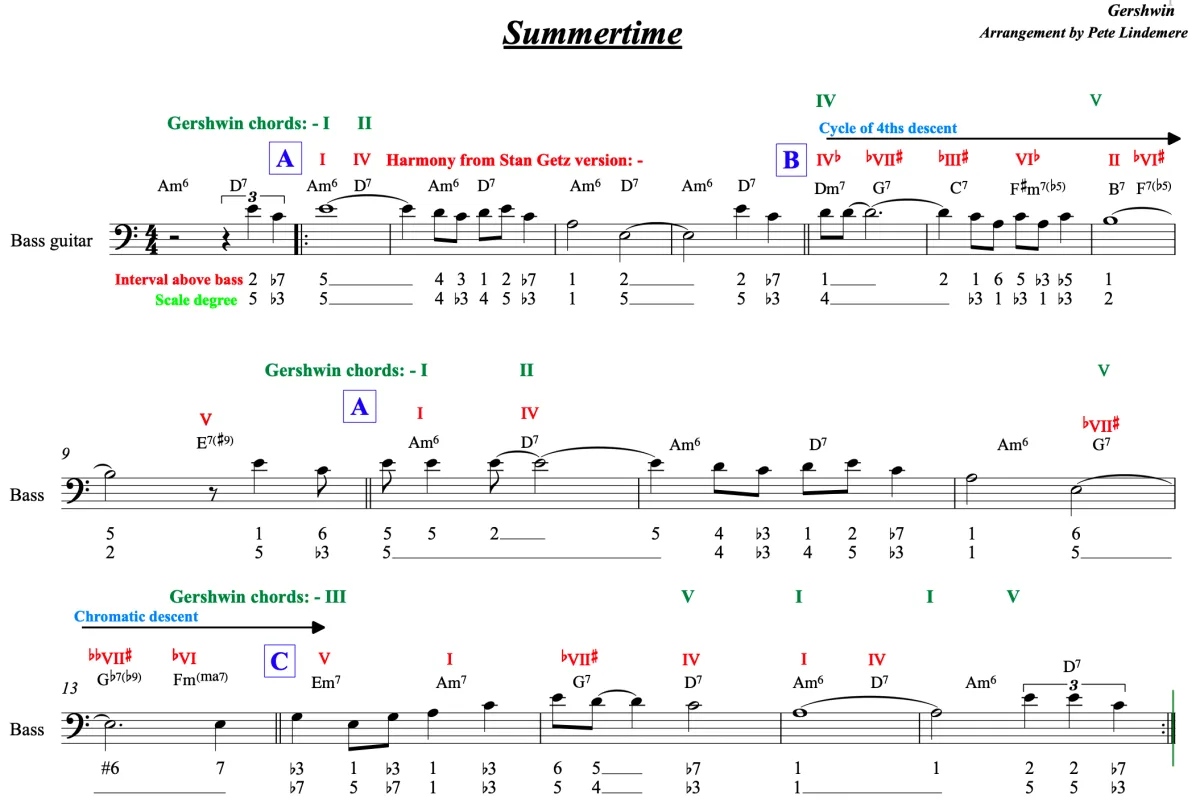
Pete's favourite, though, uses the major 3rd in both directions: Summertime, from Gershwin's 1935 opera Porgy and Bess – the diagram below maps how the melody hangs together.
Why train this ear?
Being able to name intervals and hear chord changes as they fly past is what lets you jam with strangers, work tunes out by ear, sight read, improvise and write your own bass lines – and it will eventually let you play back what you hear in your head. It's one of the best-value tools in the musician's toolbox.
Start collecting it now: the free Interval Ear Trainer deals you ten intervals to name by ear, major 3rds included – and when one slips past, it points you back to lessons like this one.