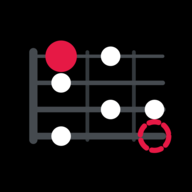
Fretboard Modemap
All seven diatonic modes on the whole bass neck, in any key. Flip the view: keep the notes and move home, or keep the root and watch the colour change. Degrees, not fingerings — and every note plays out loud.
D Dorian
Tap any note to hear it · ← → change key · the numbers are scale degrees, not fingerings.
How to use it
Modes are a relationship, not seven new scales. Take the major scale and treat a different degree as home: build from the 2nd and you're in Dorian, from the 6th and you're in Aeolian — the natural minor. Same seven notes every time; what changes is where the ear rests. That's why the tool opens in same notes view: switch modes and the notes on the neck don't move at all — only the coral home does, with a dashed ring left on the parent major's tonic so you can see where you started.
Then flip to same root. Now switching modes keeps your tonic and bends the degrees around it: D Ionian, D Dorian, D Phrygian… one home, seven colours. This is the jamming view — hold one root with the band and try each mode over it, and the differences stop being theory and start being sound.
Find the colour note. Each mode has one degree that does most of the talking — Dorian's bright ♮6, Phrygian's pressing ♭2, Lydian's floating ♯4, Mixolydian's bluesy ♭7 — shown in blue on the neck and in the strip. Lean on it when you play and the mode announces itself; avoid it and you're just playing the parent scale in a different place.
Hear everything. Tap any note for real bass pitch; press Play it and the mode climbs from the tonic while the neck and the formula strip light each degree together. Pete's own route into the modes is different and brilliant — he builds all seven from four small tetrachord chunks — and the two approaches meet in the middle: Demystifying the Modes for the method, this tool for the map. The Complete Guide to Tetrachords writes the chunks up with two free PDFs.
Practice tip
Put on a one-chord vamp, hold same root view, and spend two minutes in each mode from Lydian down to Locrian — that's brightest to darkest, one degree flattening at a time. Make the colour note the last note of every phrase. By Locrian you'll know each mode by feel, which is the only way that matters on a gig.
Scales first, modes second? Start on The Infinite Fretboard — the five scale families this tool grows out of — and Pete's map of bass scales.
Keep it in your pocket
The Fretboard Modemap installs as an app: its own icon on your home screen, full-screen with no browser around it, and — once installed — it works with no signal at all. Seven modes, twelve keys, the whole neck — in the rehearsal room, at a jam, on the bus.
To install: look for “Install” or “Add to Home Screen” in your browser’s menu.
Installed — look for the Modemap icon on your home screen. This tab is still the website.
You’re in the app
This is the installed Fretboard Modemap, not the website — it works even with no connection. Everything else, from the free lessons to Pete himself, lives at theinfinitebass.com.
Modes in the head? Now get them in the hands
A mode you can see is a mode you can reach for on purpose — and turning that map into music is exactly what Pete's lessons are for.
Also in the free tools: The Infinite Fretboard, the tuner, the metronome, the Groove Trainer and the Interval Ear Trainer.