Good timing isn't a gift — it's a skill, and bass practice with a metronome is only half of how you build it. The other half is learning to keep time with no click at all, so the pulse comes from inside you. Pete's students know that pulse by the name on his teaching room wall: the inner clock.
The short answer
Practise with a metronome in interactive ways — fewer clicks, not more — then repeat the same exercises with the metronome switched off. The click gives you an external reference to measure yourself against; the silence forces you to generate the pulse yourself. Cycle between the two and you are training both halves of your timekeeping brain — and building an inner clock you can trust on a gig.
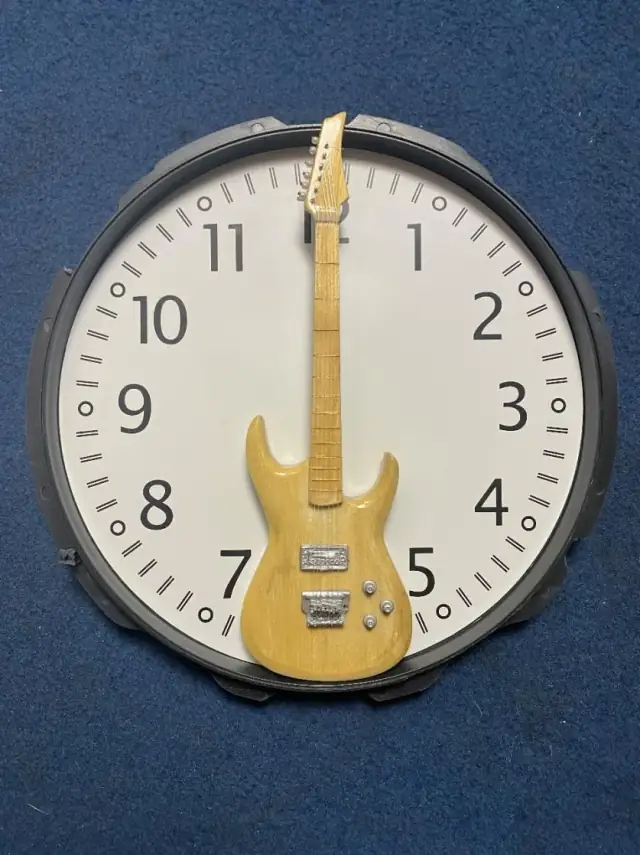
Below: what timekeeping actually asks of a bass player, the 200-year argument over the metronome (and what science says about it), the click settings that genuinely build your clock, how to push and pull the beat like the funk players do — and a whole toolbox of ways to sharpen your timing with no instrument in your hands at all. Prefer it on paper? The printable PDF is at the bottom ↓
Timekeeping: the bass player's job description
“The best way to learn is through the powerful force of rhythm.”
— attributed to Wolfgang Amadeus Mozart
Part of the job description of a bass player is to provide the harmonic foundation for the chords, melody or vocal line above the bass line, and to provide the metronomic and rhythmic link between those and the drum kit — keeping a regular pulse, or tempo (from the Italian for time), and bridging the gap between rhythm and harmony in a creative, musical and interesting way.
Sometimes the bass has to replace an absent drum kit altogether. To compensate for the lack of a drummer while accompanying his mother singing, Larry Graham started thumping his bass strings to replicate a bass drum and plucking them to replicate the pop of the snare — and slap bass was born. In other settings the bass simply is the rhythmic anchor: an acoustic duo, or the classic jazz trio of bass, piano and sax.
On the whole, being a major part of the rhythm section, the bass player's job is to lock in and complement whatever drum or percussion pattern is being played, and to provide good timekeeping at a steady tempo. Some would add that it's the bass player's job to keep the tempo — some jazz and rock bass lines tend to push slightly ahead of the drums, while other players sit behind the beat and follow the drummer. A lot of funk bass has that laid-back feel — Bernard Edwards' playing with Chic is a good example. More on pushing and pulling the beat later, because you can practise it.
Beat, rhythm and tempo are three different things
Students often confuse beat and rhythm — but playing on the beat is not the same thing as playing rhythmically. The beat is the regular pulse, which can be metrically structured into groups beginning with a strong downbeat — that grouping is what gives us our perception of metre, or time signature: 3/4, 4/4 and so on. Rhythm is the various ways the beat can be broken down and subdivided. And tempo is the speed at which the beat occurs, measured in beats per minute — BPM. A slow blues might sit at 60 BPM, a dance track at 120 or faster, and some jazz tunes — especially bebop — get up to 300 BPM!
If reading and counting those subdivisions is new to you, start with Pete's beginner lesson on bass rhythms and notes — this lesson is about training the clock that plays them.
So there are a few things to consider about timing, and about how to improve your rhythmic awareness — to become, in the words of psychologist Carl Seashore, “precision conscious of rhythm” (Seashore 1967, p. 371).
To click, or not to click? That is the question
There is a long-standing debate over metronomes: their educational value, and whether they help or harm a player's rhythmic awareness. Why would a small clicking box create such a hostile divide in the musical world? Here's one anonymous forum comment — by no means alone in its opinion:
“A teacher would ban the metronome, if he is clever enough to realize that practicing according to the metronome destroys the music, and turns that player into a brainwashed, boring, run-of-the-mill player… Throw the metronome out of the window, and fight for something worth fighting for: humanity and intuition.”
— an anonymous music-forum commenter
So the metronome is a threat to music, the mind, the soul and the very existence of humanity? That seems a little harsh for a device that has helped — and is still helping — people with Parkinson's disease, ADHD, autism and brain injury, where rhythmic cueing and interactive metronome training are used therapeutically (Nelson 2012; McGrew 2013; Rose et al. 2019). And that's before you count the musicians across two centuries who have found it genuinely useful.
More to the point: there is no empirical data behind the claim that the metronome is ineffective or detrimental to musical ability, timekeeping or expressive playing. The scientific evidence points the other way — more on that in a moment.
From Galileo to Maelzel: a short history of the clicking box
The argument is older than you might imagine. The metronome traces its origins to Galileo, who around 1602 worked out that a pendulum takes equal time on its forward and backward swing — the beginning of mechanical timekeeping (and strikingly similar to the timekeeping built into human walking, which we'll come back to). The first adjustable metronome was built by the musician Étienne Loulié in 1696 — completely silent, so you had to watch it to play in time with it, rather like watching a conductor's baton.
Then in 1816 Johann Maelzel — who had spent years building lifelike clockwork automata — produced his version. At least, he invented the word “metronome”; the design itself was borrowed from the Dutch inventor Dietrich Nikolaus Winkel. Maelzel's wind-up pendulum machine is the one we all recognise, and he described it with total confidence as an “Instrument/Machine for the Improvement of all Musical Performance”. Thence followed the controversy!
Beethoven had an interesting relationship with Maelzel. After they met in Vienna, Maelzel asked him — the first composer to specify tempo markings in a score — to write a piece for his newly invented panharmonicon, a mechanical instrument that mimicked an orchestra. The friendship collapsed when Maelzel claimed the resulting piece (which became the Battle Symphony, Op. 91) as his own — and Beethoven's dislike of the metronome soon followed. He mocked its incessant, unwavering tick, and according to Schindler he finally declared: “No metronome at all! Those who have a right feeling do not need it, and those who have not, will not be helped by it.” (Bonus 2010, p. 117)
The jazz world, on the other hand, has produced generations of advocates. In Paul Berliner's Thinking in Jazz, double bassist Calvin Hill describes practising faithfully with a metronome and even leaving it running while doing chores, “to absorb its delineation of time” (Berliner 1994, p. 151). Drummer Paul Wertico made his own “time much more secure” by listening to a setting of 200 at the start and end of each day — once he had memorised that tempo precisely, he could gauge every other tempo in relation to it (p. 151). And because the groove depends on holding a constant beat at any tempo, Berliner notes, many players prepare for the role by practising with a metronome (p. 350). If the musical world had truly believed the metronome useless, it would have gone the way of Maelzel's automata and ended up in a museum. It has had 200 years in which to do so.
What science says: two clocks in your head
So what actually changes when you practise with a click versus without one? Playing along to a metronome — an external pulse — primarily engages the brain's premotor system: you hear, you match, you correct. It is a feedback process. Playing to an internally generated pulse leans instead on the sensorimotor loop: you predict where the beat falls and commit to it before any sound arrives. That is a feedforward process.
That's a very simplified picture of a very complex neural system — but it underlines the practical point of this whole lesson: practising without the metronome matters just as much as practising with it, and practising with an interactive click — one that doesn't simply mark every beat for you — sits somewhere usefully between the two. Train only against the click and you've trained half a clock.
Choosing a metronome
A metronome is any mechanical or electronic device that emits a steady series of clicks or beeps at a set pulse, usually adjustable from around 5 to 300 BPM and often subdividable into different time signatures. (For reference, a normal clock's second hand ticks at exactly 60 BPM.)
Pete's recommendation: use one with a “click” sound rather than a “beep”. Here's why. When you are playing accurately, exactly on the beat — and you've balanced your bass and metronome volumes correctly — you'll get the uncanny sense that the click has disappeared, swallowed by your own note. Drift out of time, in front of the beat or behind it, and the click reappears. A sharp click gives you that feedback; a soft beep smears it.
Portable electronic metronomes are cheap, and there are plenty of free apps. In fact you don't need to buy or install anything to start today: this site has a free online metronome — 30 to 260 BPM, tap tempo, accented beats and a proper swinging pendulum — that runs in your browser and can be kept on your phone as an offline app.
The old triangular Maelzel-style mechanical metronomes are also genuinely useful — especially the ones fitted with a bell that can be set to ring on beat one of each bar, which really drives home where the downbeat is. They have their drawbacks: they can be expensive, they need winding up, they must sit on a completely level surface or the pendulum swings out of time, and the bell can become tiresome with prolonged exposure! But they are an extremely effective learning tool. Plus, they do look good.
Practising with the metronome
The important thing is to practise with the metronome in an interactive way. Working against a click that challenges you takes real focus — and focus is what improves learning — whereas playing along with a constant click on every beat can lull you onto autopilot. Every exercise that follows should also be repeated without the click, to internalise the pulse you've just been borrowing.
Find your tempo ceiling
Begin by looping as many different rhythms as you can on just one note against the click — really get into each groove and enjoy syncing with it — starting very slowly and building speed gradually as your accuracy develops. This applies to advanced students and beginners alike, because it gives you a personal benchmark: your ceiling BPM without mistakes, and a goal to move.
Slower is harder than it sounds. At slow tempos there is more space between the clicks to fill accurately — more time for things to go wrong. Pete has seen students who can play something as demanding as Charlie Parker's Donna Lee almost up to speed come unglued when asked to play it at half tempo — fast playing is not always as accurate as you might think! Speed is purely a by-product of accuracy, relaxation and solid learning of the notes and rhythms, and that only comes from slow, accurate practice. How slow is slow? As slow as it takes to play the thing perfectly, without a single mistake.
Then test the other direction to find your current limit. If you can play two-octave scales in semiquavers, fluently in any key at 120 BPM, you're doing well — that was roughly the Rockschool Grade 8 benchmark in the mid-1990s (it has since dropped to quavers at 80 BPM). If you can't play like that yet, don't be discouraged: goals like this are exactly what you work towards as a musician. And use the ratchet: if you can play something perfectly at 100 BPM, come back to it every day and nudge the tempo up by 1 BPM. In twenty days you're playing it at 120.
Count out loud, and frame your mistakes
Get used to counting out loud with the metronome. It strengthens the connections between the auditory and motor areas of your brain — and you may have to count your band in one day!
Analyse your playing as you go. If you make a mistake, stop at the mistake — don't start again from the beginning. Ask what the problem actually is: the picking hand? The fretting hand? Find the fault and put a frame around it: repeat just that fragment at a slower tempo until it stops being a problem. Ten clean repetitions in a row is a good goal. This might mean very slow tempos and a lot of repetition, but it works — it is the central move of deliberate practice, and if you want the science behind why it beats mindless run-throughs, Pete's interview with neuroscientist Dr Molly Gebrian covers it in depth.
Fewer clicks, stronger clock: settings that build timing
The common advice for any metronome work is to start slowly — 60 BPM is a good starting point — focusing on every click and making sure that what you play lands exactly on the beat. That's the foundation. But the interactive settings below are where the inner clock really gets built, because each one takes clicks away and makes you supply the missing beats yourself. For all of them, try accenting (playing slightly louder) the beat that carries the click — exaggeration has a surprisingly profound effect on how you internalise time — and then move the accent elsewhere and feel how the line changes.
Click on beat 1 only
Set the metronome to a low tempo — say 30 BPM — and treat each click as beat one of the bar. First play single crotchets right on the clicks to get a feel for the pulse. Then play a scale in quavers, then semiquavers, at the same setting. Mathematically that's no different from playing minims and crotchets at 120 — the difference is that you have to keep the time accurate through beats 2, 3 and 4, with no click to lean on. Tap your foot to find them, and count out loud. It can be quite challenging at first, and it is one of the best inner-clock builders there is.
Clicks on beats 1 and 3
Now set the click to fall on beats 1 and 3 — between 30 and 60 BPM. (“Setting” here simply means how you count the clicks: hear them as 1 and 3, and supply 2 and 4 in the gaps.) Beats 1 and 3 are exactly where the bass drum falls in a basic rock groove, so this is a very effective way to practise rock bass lines and scales in quavers. Try accenting beats 2 and 4 as you play — that's where the snare cracks — and feel the sense of drive and forward momentum it gives a quaver pulse. Counting yourself in is easy with the clicks on the downbeats, and syncopated lines sit comfortably against them.
Clicks on beats 2 and 4
Alternatively, count the same clicks as beats 2 and 4 — the backbeat, where the snare lives. Now the pulse has an off-beat feel that gives you a real sense of swing, which makes this the classic jazz setting: a great way to practise walking bass lines and scales in crotchets. It's superb for funk too, where bass lines often miss beats 2 and 4 entirely to let the snare cut through — a tight, locked-in groove built on call and response between the bass and the kit — and practising against a 2-and-4 click teaches you to feel those beats without playing them. Counting yourself in is harder, since 1 and 3 fall in the silent gaps: count “2” and “4” with the clicks and place “1” and “3” in between. It takes practice, and it will change how the metronome feels to you.
Gap metronomes: with and without at once
One way to practise with and without a metronome at the same time is a gap metronome: bars of click followed by bars of silence, so the reference keeps dropping out from under you and your inner clock has to carry the line until it returns. That is exactly what the rhythm trainer in our free online metronome is built for. Set it to play four bars and rest two — or any pattern from 1×1 up to 8×8 — and the pendulum keeps swinging silently through the rest bars, so when the sound returns on beat one you know immediately whether you held the tempo or drifted. Start generous, four bars of click to one of silence, then stretch the rests as your clock strengthens — carrying more silent bars than clicked ones is a genuine test of anyone's time. (A crueller variation mutes individual beats at random rather than whole bars — the same principle, dialled up.) It's free, it runs in the browser, and it installs on your phone as an offline app, so the practice room doesn't need a signal. These gaps can be quite challenging to practise with — which is rather the point.
Pushing and pulling the beat
“A very large part of the artistry in music lies in the utilization of these principles. Without them, accent, phrasing and rhythm would be hopelessly sterile.”
— Carl Seashore, Psychology of Music, on our capacity to feel fine shadings of time
It often comes as a surprise to students when Pete explains that you can play not only exactly on the beat, but deliberately in front of or behind it as well. This is the concept of pushing and pulling the beat: placing a note a few milliseconds either side of the pulse as a way of putting human feeling into a performance — forward momentum on one side, a relaxed, laid-back feel on the other.
Be clear about what it is not: it is not speeding up or slowing down. The tempo stays exactly the same — this is about accurate note placement against a fixed pulse. A more flexible cousin of the idea — where melodic timing genuinely bends against a steady accompaniment — is known as rubato: Mozart and Chopin were both known for keeping the left hand of a piano piece metronomically strict while the melody in the right hand sang with rhythmic freedom.
When human beings play music together — pop, rock, classical, funk, jazz — there are always slight deviations in timing between the members of the ensemble. If there were none, everyone would sound the way a phone does when it plays music: absolutely accurate and devoid of any life. Robotic, in fact. Those slight deviations in front of or behind the beat — even against a click track — are precisely where the meaning, expression and emotion live. The masters of manipulating time within a phrase make up a long list: Jimi Hendrix, Jaco Pastorius, Charlie Parker, Frank Sinatra, Ella Fitzgerald…
You'll hear both directions everywhere once you listen for them. A lot of funk sits ever so slightly behind the drums: listen to Bernard Edwards with Chic, or Bootsy Collins with James Brown. When Pete plays a funk line he likes the feeling of being led by the drums — the drum hit landing almost imperceptibly before his bass note. That's what creates a laid-back groove: “in the pocket”, as they say. A driving rock line with a strong quaver pulse, or a walking line under a fast jazz tune, leans the other way — pushed slightly in front, creating forward momentum. And the diagnosis works in reverse: a band that feels like it's dragging is usually several players sitting too far behind the beat, while beginners under stress tend to rush — pushing ahead because the need to keep up outstrips the moment. (Relaxing, and trusting the motor patterns you've trained, is usually the cure.)
How to practise pushing and pulling
The simple answer is: by trying it, slowly, against a click.
- Anchor yourself on the beat. Set the metronome between 40 and 60 BPM and play single staccato crotchets — as short as possible — exactly on each click. Pete suggests using a dead note (fretting hand resting on the string, no pitch), because its short duration lets you place it with real precision. This is your reference point.
- Push. Once you're secure, begin placing the note ever so slightly in front of each click. You are not speeding up — you'd drift out of phase with the click if you were. You're anticipating it, leading it, giving the note forward momentum.
- Return to centre, then pull. Relax back until you're exactly on the beat again. Then let the click lead you: hear it first, relax further, and place your note fractionally behind it.
- Extend it. Repeat the exercise with quavers, then with a scale or a bass line you know well. Stay consistent — if you're pushing, stay the same distance in front; if you're pulling, the same distance behind. You'll be surprised how much leeway there is either side of the beat once your placement is deliberate.
Practising with a drum machine
A drum machine — hardware, an app, or the endless free drum loops on YouTube — offers something the metronome can't: the experience of locking in with a kit. Working with one builds your sense of how the bass interacts with each part of the drum pattern to create a tight groove:
- Lock to the bass drum — start with one note played exactly with the kick pattern, then try something more melodic: a scale fragment, or an octave pattern.
- Play off the snare — or skip the kick entirely and focus on the snare; practising slap pull-offs against it is very effective.
- Follow the hi-hat — if it's ticking in semiquavers, match that subdivision with a line or a scale.
- Answer the toms — a descending tom fill invites a descending bass answer with a similar rhythm.
You don't need to install anything to try all four: this site has a free Groove Trainer — a browser drum machine built around exactly these exercises. Tap a drum's name to silence its row and lock to what's left; program your own bar on the 16-step grid; and its rhythm trainer mutes the whole kit for a bar or two at a time — the gap drill from earlier, applied to a groove. The tom row is left empty on every preset: that part of the conversation is yours. Like the metronome, it installs as an app and works offline.
Still worth your time is the Groove Pizza, a free browser drum machine from NYU's Music Experience Design Lab that approaches rhythm from a fascinating angle: each groove is drawn as slices of a circle — kick, snare and hi-hat as geometry — so you can see the shapes and symmetries inside the patterns you're locking to. Its co-creator Ethan Hein has written an interesting account of how it evolved, maths and all.
The other advantage is style. Playing a Latin line or a bossa nova against the right drum groove — or a reggae, jazz, rock, funk or dance pattern — pulls you into the spirit and feel of each style while improving your rhythmic awareness. (Each of those links opens the Groove Trainer with that groove already loaded.) But for building the inner clock itself — total focus on the beat, without distraction — the metronome wins, hands down. Use both.
Building the inner clock: practising time without any device
Metronomes and drum machines are training aids. You should not rely on them alone — you should also practise completely unaccompanied, just you and the bass, generating the pulse yourself and noticing whether you speed up, slow down, or hold steady. A good sense of rhythm and pulse should come from within; it should be part of you as a musician. Here is a whole toolbox for training it — much of it usable with no instrument in your hands.
Just you and the bass
Play an exercise for five or ten minutes with the metronome, then repeat the same exercise without it — and record yourself. Stepping back and analysing your own playing is remarkably effective: you'll hear exactly where your unaccompanied time differs from your clicked time. Eventually the gap between the two becomes insignificant. That's the inner clock arriving.
Tap your feet — and more than your feet
Tapping your foot while you play is the most natural internalisation tool there is — you've probably been doing it to music all your life. Take it further: everything you practised interactively with the metronome — the click on beat 1 only, on 1 and 3, on 2 and 4 — can be replicated with your feet instead of the click. Try as many tempos, rhythms and lines as you can against your own taps; your foot will tell you a lot about your timing. Switch from right foot to left, or right heel to left heel, when you tire. Playing off-beat or syncopated patterns between your foot taps is another very effective drill. And when sitting, try tapping your heels: larger muscle groups have proved, in rhythmic motor-pattern research, to be more metronomically accurate than smaller ones — part of why whole-body movement is such good timing training.
Get to know tempos cold
Remember Paul Wertico memorising 200 BPM until he could gauge every other tempo from it? You can build the same internal reference library. BPM-counter and tap-tempo apps grew out of exactly this need: tap along to a song on your phone and it tells you the tempo. Do it enough and you start to know what 90 feels like, what 120 feels like — and you'll be the one who counts the band in at the right speed. (The tap-tempo button on this site's metronome works for this too: tap what you think 100 BPM is, then check yourself.)
Clap the beat
It may sound simple, but clapping is a highly effective way to become precision-conscious of timing and rhythm — best done with a metronome, a drum machine or along to a track. Clap on the beat, off the beat, on beats 1 and 3, on beats 2 and 4; clap different rhythmic groupings; clap along with a vocal or an instrumental line. In every case, focus hard on your own precision — and notice that the disappearing-click test works here too: clap exactly on the beat and the metronome vanishes into your hands; slip out of time and it reappears. Try it — the results can be very rewarding.
Tapping exercises: fingers, thumb and a pencil
Scientific studies have repeatedly shown distinct improvements in students' instrumental timing and rhythmic awareness when they practise simple, regular tapping tasks — with the fingers or a pencil — because tapping lets you focus completely on timing and motor precision for extended periods. Tapping exercises train the mind as much as the fingers, and you can do them anywhere there's a surface: a table, your leg, your knee. Pete used to sit near the British Rail clock while waiting for the train to university — ticking away at a steady 60 BPM, it made an excellent metronome for picking-finger tapping practice. Never miss an opportunity!
- Tap with the picking fingers. Rest your forearm on a table, arch the hand, and tap with the fingertips, mimicking the action of playing the strings. Work fingers 1 and 2 individually first, tapping out different rhythms to build accuracy in each finger, then alternate them (expand to three fingers if that's how you pick). The individual work also tells you your alternating speed: if either finger can tap accurate semiquavers at 60 BPM, the two alternating should manage semiquavers at 120.
- Climb the rhythm ladder. Crotchets first, each finger alone and then alternating — then quavers, swung quavers, quaver triplets, semiquavers, and finally semiquaver triplets. After that, mix rhythmic groupings: a galloping rhythm (a quaver followed by two semiquavers), then its reverse, then whatever you can invent. Improvising rhythmic groupings over a steady pulse builds the habit of being rhythmically inventive.
- Mimic slap with a pencil. Hold a pencil between thumb and finger at 90 degrees to the hand and tap the table with a twisting motion from the wrist — the motor pattern of slap bass — or rest the forearm and twist to tap with the thumb itself. Foot tapping along, as ever.
The pencil exercise: picking practice with built-in timing
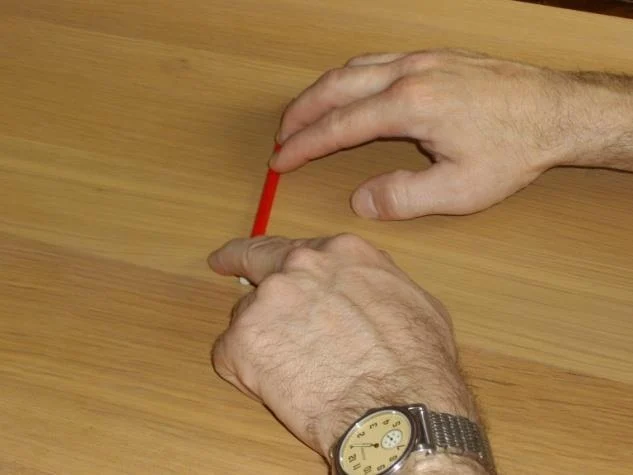
Then there's the pencil's other job: substitute string. Hold it flat on the table with the fretting hand and practise picking against it. Working against the pencil's resistance is a very good way to improve and shorten the picking stroke — the distance the picking fingers travel away from each other as they alternate. As one finger picks against the pencil and slips off to hit the table, the next should take its place, lifting only high enough to rest on the pencil. Keep the picking hand completely relaxed, keep fingers 3 and 4 resting on the table — and tap your foot as you work through different subdivisions and rhythmic groupings, so the drill trains your clock along with your picking technique.
Visualisation: mental practice in strict time
The imagination is a seriously underrated practice tool — Jaco Pastorius remarked on his teaching video that he did most of his practising away from the bass, just by thinking about it. You can visualise your hands performing any action — technical exercises, intervals, scales, arpeggios, triads, 7th chords, bass lines, melodies, improvising — and hear the sounds in your mind as they do so. Visualisation genuinely strengthens the neural pathways between the auditory and motor areas of the brain. Consider which fingers you'd use and which strings you'd play a scale on; feel the dynamics, the shifts, the picking and fretting actions; see the patterns on the fretboard, the note names, the notation. The most important thing is to imagine it all in strict time, to a metronome. The more you try it, the more effective it becomes — and you can do it in a queue, on a bus, anywhere.
Two more uses for it. When you hear an unfamiliar bass line or melody on the radio or television, try to imagine how you would finger it on the bass — the results when you finally pick the instrument up and try it for real can be quite interesting! And if a gig, audition or recording session is looming, visualisation is a very effective way of preparing the mind and easing stage fright: take yourself through the performance and see yourself playing everything flawlessly, in perfect time, your hands working efficiently and producing the ideal sound. It works best lying in bed just before sleep — and it's particularly effective when you're learning new material for a performance.
Sing everything
Very few things improve your ear and internalise harmony, melody, timing and rhythm more effectively than singing or vocalising — it strengthens those same auditory–motor pathways. Pete's rule for his students: if you can sing it, you can play it (even if it sometimes takes a while!). You don't have to be a great singer. Say note names out loud, sing the scale degrees of arpeggios, verbalise rhythms, count along with the metronome — though you might not want to start practising intervals in a restaurant or at the cinema. And when you're listening to music, try singing along not just with the vocal but with every part — the bass line, the guitar riff, the keyboard part — concentrating on the timing and subdivisions of each, tapping your feet as you go. Vocalise what you play whenever you practise, too: it educates your ears and your fretboard fluency at the same time. (And bear in mind that a bass player who can also hold down backing vocals is a more versatile, more employable musician — it will always improve your chances of getting band work.)
Read scores away from the bass
Many musicians advocate studying notated music away from the instrument, because score reading is such an effective way of internalising musical values and note timings. The easiest way in: follow a piece you know well — any line, vocal, piano or bass — while listening to it, tapping your foot in time as you go. You'll absorb note values, melodic shape, pitch direction and intervals, and strengthen your sense of pulse while you're at it.
Walk — your feet are a metronome
While you're walking, your feet behave much like a metronome: each step can be measured in beats per minute, and Galileo would recognise the pendulum swinging in your stride.
Walking tempo, roughly
| A slow, leisurely stroll | 80–90 BPM |
|---|---|
| Normal walking speed | 100–110 BPM |
| A fast walk | 120–130 BPM |
Broad estimates with plenty of overlap, of course — but as you walk at a steady pace, your footsteps hand you a free, reliable beat to visualise playing along to. Imagining walking bass lines comes to mind — well, it would, wouldn't it! But scales, arpeggios, any line or melody can be played in your imagination over that metronomic accompaniment, and it is very good training for internalising a solid sense of time.
Move, full stop
It's no accident that the research keeps pointing at the body. Studies of rhythmic motor patterns indicate that percussionists tend to have an unusually accurate sense of time — they spend their lives striking on the beat with large, committed movements — and there is good evidence that dancing, which entrains the whole body to a pulse, strengthens timekeeping and the internal sense of rhythm too (the stepping tasks in Rose et al. 2019 are a glimpse of the same effect). Clap, drum on your knees, step in time, dance around the kitchen. It all feeds the same clock.
The bottom line
The metronome is neither the enemy of feel nor a magic fix — it's a training aid, and a superb one when you use it interactively: fewer clicks, slower tempos, accents moved around, silences programmed in. The device it's training is you. So cycle deliberately — with the click, then without it; on the beat, then either side of it; on the bass, then away from it entirely, singing and tapping and walking your lines. Do that consistently and the gap between your clicked time and your own time shrinks until it stops mattering. That's the inner clock: the one timepiece you'll never leave in the rehearsal room.
Timing questions bass players actually ask
- Should I always practise bass with a metronome?
- No — and that's the point of this lesson. Practising with a click trains accuracy against an external reference (a feedback process); practising without one trains you to generate the pulse yourself (a feedforward process). Both systems need work, so alternate: run an exercise with the metronome, then repeat it unaccompanied and compare. The rhythm trainer in our free online metronome automates exactly that alternation — a few bars of click, then silent bars where you carry the pulse yourself, and the returning beat one tells you how you did. (The groove trainer applies the same drill to a whole drum kit.)
- What tempo should a beginner set the metronome to?
- Start around 60 BPM for general work, and drop to 30 BPM for the interactive drills where the click marks only beat one. The honest rule isn't a number, though: go as slow as it takes to play the passage perfectly. Accuracy at slow tempos is what fast, clean playing is built from.
- Does practising with a metronome ruin your feel?
- There's no empirical evidence that metronome practice harms timekeeping or expressive playing — the research points the other way, and metronome-based training is even used therapeutically for Parkinson's disease, ADHD and brain injury. Feel comes from deliberate note placement — pushing or pulling the beat — and you learn that placement fastest against a steady reference.
- What does playing behind the beat mean on bass?
- Placing your notes a few milliseconds after the pulse while the tempo stays exactly the same — the laid-back, in-the-pocket feel you hear from Bernard Edwards or Bootsy Collins. Playing in front of the beat (pushing) is the opposite: the note lands fractionally early, giving rock and up-tempo jazz lines their forward momentum. Neither is speeding up or slowing down — it's placement, and you can practise it.
- What's the difference between beat and rhythm?
- The beat is the regular pulse, grouped by the metre (3/4, 4/4) starting from a strong downbeat. Rhythm is how that beat is broken down and subdivided into patterns. Tempo is the speed of the beat, in BPM. Playing on the beat and playing rhythmically are related skills — but they are not the same skill.
- Can I improve my timing without an instrument?
- Yes, substantially. Vocalise rhythms and count out loud; clap and tap rhythms against a click (tapping tasks measurably improve instrumental timing); tap your feet (heels engage larger, more metronomically accurate muscle groups); follow a score while tapping; visualise playing in strict time; and walk — a steady stride runs at roughly 80–130 BPM, a free metronome you carry everywhere. Percussionists and dancers keep better time than most musicians for exactly this reason: the body is the clock.
References
- Berliner, Paul F. 1994: Thinking in Jazz (Chicago: The University of Chicago Press)
- Bonus, Alexander Evan. 2010: The Metronomic Performance Practice: A History of Rhythm, Metronomes, and the Mechanization of Musicality (Case Western Reserve University)
- McGrew, Dr Kevin S. 2013: The Science Behind Interactive Metronome (A MindHub™ Pub: #2 3-4-13 v1.1)
- Nelson, L. 2012: Effects of Interactive Metronome on cognition and electrocortical functioning in recovery from blast-related brain injury (Presentation Conference, San Antonio, Texas)
- Rose, Dawn; Delevoye-Turrell, Yvonne; Ott, Laurent; Annett, Lucy E.; and Lovatt, Peter J. 2019: Music and Metronomes Differentially Impact Motor Timing in People with and without Parkinson’s Disease (Parkinson’s Disease, Volume 2019, Article ID 6530838)
- Seashore, Carl E. 1967: Psychology of Music (New York: Dover Publications Inc.)
Timing is the fastest thing to fix with a second pair of ears in the room — book a one-to-one lesson with Pete, online or in person in South Wales, and he'll tell you in minutes whether you push, pull or drift.
Notes