So what does diatonic mean? It isn't vague. It has a strict definition, a formula you can count on your fingers, and a history running from a Mesopotamian clay tablet to the chord chart on your music stand.
The short answer
Diatonic refers to the major scale — the Ionian mode — and to every interval, mode and chord that can be built from it. Which is why you'll often hear it used to mean simply "in the key". If a note, chord or scale comes out of the major scale you're sitting in, it's diatonic. If it has been altered chromatically, it isn't.
Ask ten musicians and you'll get ten answers, most of them starting with "well, it's sort of…" — which is exactly why it's worth writing down properly. Below: where the word comes from, the three rules a scale has to pass, the intervals, chords and modes that fall out of it, and the one famous scale that almost qualifies. Prefer it on paper? Pete's PDF is at the bottom ↓
Where the word comes from
The word has several interpretations, and they all stem from the ancient Greek dia tonos. That term referenced one of the three types of tetrachord in use at the time — diatonic, chromatic and enharmonic. Depending on who is translating, dia tonos comes out as "across strings", "through tones", or "proceeding by whole tone".
The most accurate is "stretched out", and that one is worth holding on to, because it refers to the tetrachord that was left unaltered — neither chromatically nor microtonally adjusted. Which is, in itself, a very good way to think about what diatonic means: chromatically unaltered.
The formula: what actually makes a scale diatonic
For a scale to be called diatonic, it has to satisfy three conditions. Not two — all three.
- It must be a seven-note scale (heptatonic).
- It must be built from two semitones and five whole tones.
- The two semitones must be separated by no less than two whole tones.
That third rule is the one that does the work, and it's the one people forget. It rules out everything except the major scale — the Ionian mode — and its subsequent modes, which between them correspond to all the white notes on a piano keyboard.
The construction is T T S T T T S (tone / semitone), or if you learned it the American way, W W H W W W H (whole step / half step — all the British and American musical terms, side by side, if you want the full list):
The same pattern, counted three ways
| Steps | R | W | W | H | W | W | W | H |
|---|---|---|---|---|---|---|---|---|
| Tones / semi | R | T | T | S | T | T | T | S |
| Semitones | R | 2 | 2 | 1 | 2 | 2 | 2 | 1 |
Diatonic intervals, chords and modes
Once the scale is built, everything that comes out of it is diatonic too. Each degree has a name and a job:
Diatonic intervals and their functions, in C
| Interval | 1 | 2 | 3 | 4 | 5 | 6 | 7 | 8 |
|---|---|---|---|---|---|---|---|---|
| Function | Tonic | Supertonic | Mediant | Subdominant | Dominant | Submediant | Leading tone | Tonic |
| Note name | C | D | E | F | G | A | B | C |
Stack thirds on each of those degrees and you get the seven diatonic chords — and start the scale from each degree in turn and you get the seven modes. Same seven notes every time; only the starting point changes.
Diatonic chords and modes of C major
| Chord | I | ii | iii | IV | V | vi | vii | I |
|---|---|---|---|---|---|---|---|---|
| Chord name | Cmaj7 | Dmin7 | Emin7 | Fmaj7 | G7 | Amin7 | Bmin7♭5 | Cmaj7 |
| Mode | Ionian | Dorian | Phrygian | Lydian | Mixolydian | Aeolian | Locrian | Ionian |
If the modes row is where your eyes glaze over, that's normal — and there's a way to make them stick. Pete's tetrachord method for demystifying the modes breaks all seven down into just four small shapes — and it's the lesson people write in about.
Two tetrachords, a tone apart
There's a second way to describe the diatonic major scale, and for a bass player it's the more useful one. Split the octave in half and you get two tetrachords — tetrachord being nothing more frightening than another word for a four-note scale (tetra = 4, chord = strings). Pete has a whole lesson on them — the complete guide to tetrachords, with two free printable PDFs — because the same trick that builds the major scale here goes on to build 49 scales.
Take a lower major tetrachord, C D E F. Add an upper major tetrachord a whole tone above it, G A B C. Two identical shapes, one tone apart:
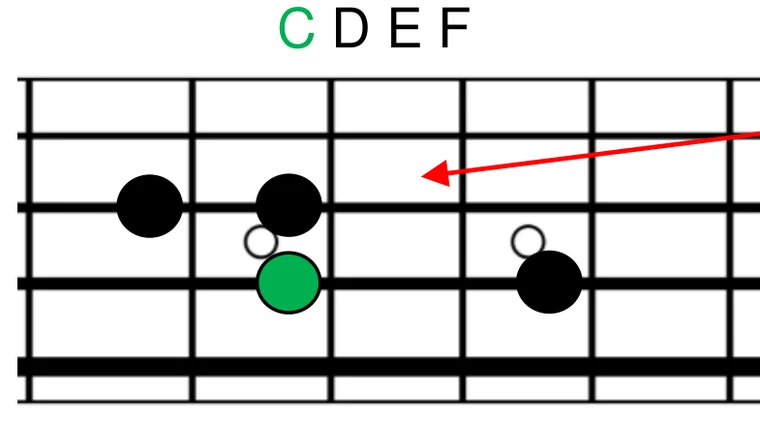
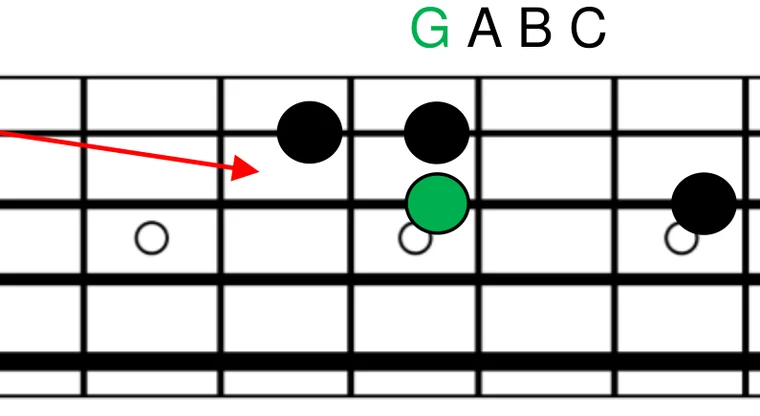
Put them together and you have the whole thing: C D E F G A B C — the Ionian mode, the major scale, chord I.
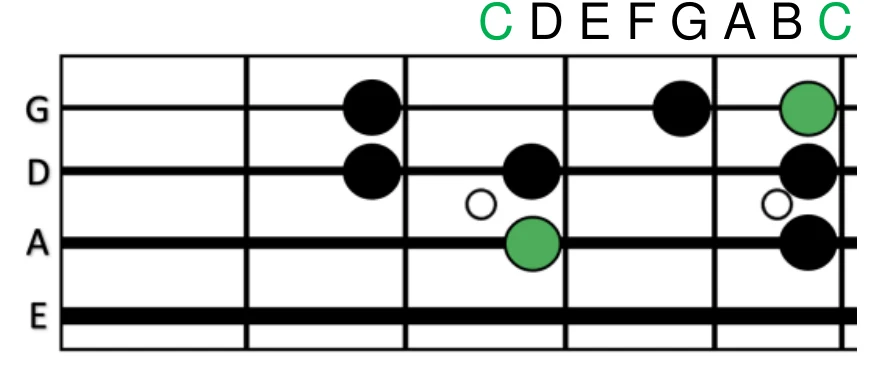
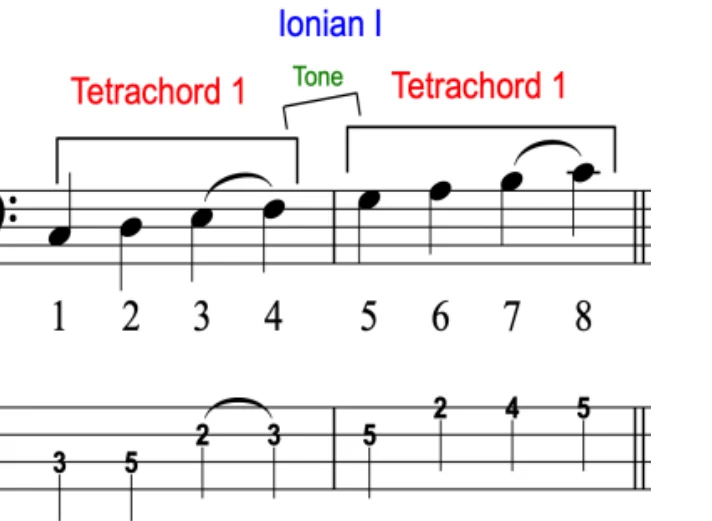
It's all in the voice
Here's the part that tends to surprise people. The harmonic series is present in human speech. The overtones in the sound of a speaking voice contain all twelve notes of the chromatic scale — but more interestingly, the higher peaks of those overtones correspond to the major and minor pentatonic scales — the five-note scale that gets its own complete lesson here.
Which makes it rather less surprising that a stone-age flute has been found — reckoned to be over 40,000 years old — tuned to the pentatonic scale. This is a natural way through which we hear and perceive music. Our ears are attuned to do it.
And here it is in a human voice. Plot the mean amplitude of the overtones in speech against frequency ratio, and the peaks land on the intervals we use most. The unison towers over everything else; below it the thirds and the fourth carry the most, then the fifth — and the octave rises back to a clear peak of its own at the right-hand end.
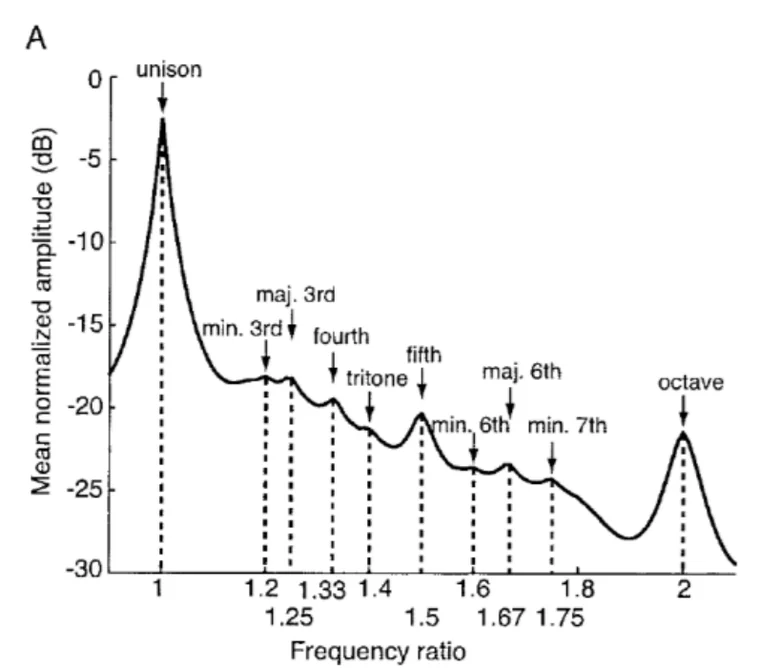
Humans prefer tones, and chords, that are similar to the harmonics of human vocalisation. Over the millennia that has produced a preference for collections of intervals that most resemble the harmonic series and the human voice. Certain intervals of the chromatic scale — the fifth, the fourth, the major third and the major sixth — are used far more often than the others in composition and performance.
Those intervals make up the majority of what you find in the pentatonic and the diatonic major scale and modes: the two most frequently used scales in music worldwide. It is perhaps not a coincidence that the most-used scales across so many different cultures are the Dorian, Phrygian and Major scales — the ones closest in spectra to the harmonic series.
Worth a detour: if intervals are what the diatonic scale is made of, Pete has a lesson on each of the useful ones — every one pinned to a tune you already know.
- Semitones — the Jaws theme
- Major 2nds — Strangers in the Night
- Minor 3rds — Mad World
- Major 3rds — Summertime
- The perfect 4th — All The Things You Are
Why seven notes?
The reason the diatonic scale has seven notes is probably lost in the mists of time. Consider that there is a gap of more than 35,000 years between that first pentatonic bone flute and the documented use of a seven-note scale by the Mesopotamians — recorded on a famous clay tablet dated to roughly 600 BC, itself believed to be a copy of an older tablet from around 1800 BC.
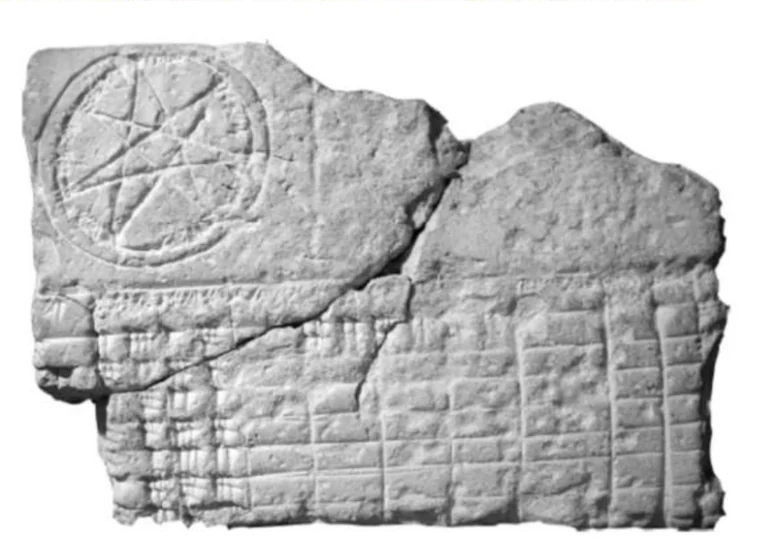
That is more than enough time for the pentatonic scale to acquire two extra notes. But there is likely more than one reason why the seven-note heptatonic scale developed as it did, and why it became so popular across so many different cultures:
- The two added notes bring tension that is satisfying when resolved. The pentatonic scale has no tension notes — no 4th, no 7th.
- They allow smoother singing, letting the voice rise and fall in smaller steps.
- They allow more freedom of expression and melodic inventiveness.
- There may be a connection between the seven notes and the seven days of the week, and the seven known planets of the time.
- The circle of 5ths was known to the Mesopotamians — and stacking seven intervals of a 5th on top of each other creates a diatonic scale.
- The intervals of the seven-note diatonic scale are present in the harmonic series, as they are in the overtones of the human voice.
- Seven-note diatonic scales are close in spectra to the harmonic series.
Close, but no cigar — the melodic minor scale
The melodic minor is the best test of whether the definition has landed, because it looks like it ought to qualify and doesn't.
It differs from the major scale by exactly one note: a minor 3rd instead of a major 3rd. Seven notes — tick. Two semitones and five whole tones — tick. But look at where those semitones fall:
Melodic minor construction, in C
| Interval | 1 | 2 | ♭3 | 4 | 5 | 6 | 7 | 8 |
|---|---|---|---|---|---|---|---|---|
| Note name | C | D | E♭ | F | G | A | B | C |
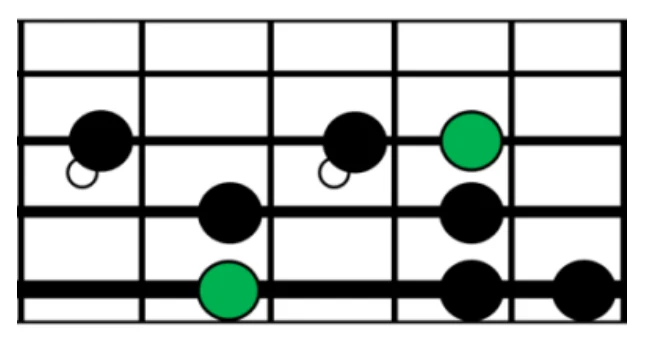
So it fails on rule 3, and that alone settles it: the melodic minor is non-diatonic.
There's a second reason too. There's a compositional practice of using the scale in its natural form on the way up (major 6th, major 7th), then flattening the 7th and the 6th on the way back down — which also detracts from the scale being considered diatonic. Bach broke that "rule" frequently in his own compositions, mind you. For a more up-to-date example of the accepted way of using the melodic minor, listen to Yesterday by the Beatles.
From a clay tablet to a chord chart: a short history
As we've seen, the Mesopotamians were the first to document the use of diatonic scales — a good thousand years before Pythagoras began describing them in mathematical terms using ratios, around 520 BC: 2:1 is an octave, 3:2 is a 5th, 4:3 is a 4th, and so on.
To the ancient Greeks, who inherited the modes, the Dorian mode (what we now call the Phrygian mode) was among the most commonly used. It became central to ancient Greek music and culture — it was their C major — and was held in the highest esteem by both Plato and Aristotle.
The church modes
The music of the early Christian church arose out of the culture of the classical Mediterranean, and the diatonic modes of ancient Greece were simply part of the musical furniture of that region at that time.
The names of those modes then suffered some confusion, partly down to Boethius, who mis-named them in his music theory treatise De institutione musica of 510 AD — an error we are all still living with.
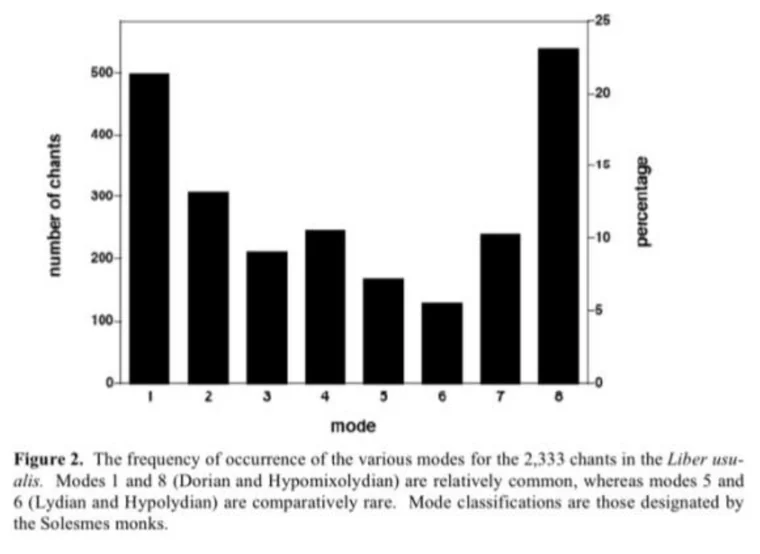
Early Christian plainsong (plainchant) used the Greek modes for the unaccompanied singing of psalm melodies. Interestingly, the Dorian turns up again as one of the two dominant modes, alongside the Hypomixolydian — the plagal version of the Mixolydian, beginning a 4th lower. Count the chants and it shows up plainly:
The Renaissance (1400–1600)
The Renaissance saw the rise of polyphony — multiple voices in harmony — as secular music began pushing the boundaries of diatonic modal composition with ever more daring chromaticism. This paved the way for the major–minor tonal system we call functional harmony.
In 1547 the theorist Glarean proposed adding four more modes to the eight that already existed: Ionian (major) and Aeolian (minor), along with their respective plagal modes beginning a 4th lower. He noted that the Ionian mode was the one most frequently used by the composers of his day — and with the development of musica ficta (chromatic alteration of modal melodies to avoid dissonance), music was certainly heading in that harmonic direction.
The common practice period (1600–1900)
The major–minor system was born in the tonal music of the common practice era, through a funnelling of the modes into a more harmonic world of cadences dominated by chords IV and V. The result was the goal-oriented plagal and perfect cadences that define the music of that period, and the major scale and natural minor scale becoming the two favoured diatonic scales, used almost to the exclusion of everything else.
Almost. Beethoven is known to have used the Lydian scale in one of his string quartets. And eventually there was a return of sorts to the diatonic modes in the music of Stravinsky, Bartók and Debussy — as well as in the jazz and pop music of the 20th and 21st centuries, which is where most of us met them.
Diatonic: the questions people actually ask
- Is the minor scale diatonic?
- The natural minor is — it's the Aeolian mode, the sixth mode of the major scale, so it is made of the same seven notes and passes all three rules. The melodic and harmonic minors are not: their semitones sit too close together. (The whole minor family — where it came from and every member's construction — has a lesson of its own.)
- Is the pentatonic scale diatonic?
- No. It has five notes, and rule 1 asks for seven. Its notes are all drawn from the diatonic scale, which is why it fits over diatonic harmony so comfortably — but the scale itself isn't diatonic.
- Is the blues scale diatonic?
- No. The blues scale is the minor pentatonic with a chromatically added ♭5 — and "chromatically added" is exactly the thing diatonic rules out. There's more on how that one note works in the pentatonic scale lesson.
- What's the difference between diatonic and chromatic?
- Diatonic means the notes belong to the key you're in. Chromatic means they've been altered — borrowed from outside it. Remember the best translation of dia tonos: "stretched out", meaning unaltered.
- Are all seven modes diatonic?
- Yes. Ionian, Dorian, Phrygian, Lydian, Mixolydian, Aeolian and Locrian all contain the same seven notes as their parent major scale — only the starting note changes.
- Why does any of this matter to a bass player?
- Because "diatonic" is the shorthand every other musician uses for safe in this key. Knowing which notes are diatonic tells you what will land under almost any chord, and knowing which aren't tells you where the interesting notes are hiding.
Want this under your fingers rather than just in your head? Book one-to-one bass lessons online with Pete, or in person in South Wales.
Notes