Throughout human history, the minor scale has been the dark shadow of the major scale — yet two forms of minor mode have been humanity's favourite scales for the last 3,000 years. It is only in the last 400 that Western music has leaned so heavily towards the major. This is the story of the minor scale — where it came from, why it sounds the way it does, and every member of its family, on the bass.
The short answer
A scale is minor when its 3rd sits three semitones above the root instead of four. The natural minor scale is 1 2 ♭3 4 5 ♭6 ♭7 — in C, that is C D E♭ F G A♭ B♭. Raise its 7th and you get the harmonic minor; raise the 6th as well and you get the melodic minor — and those three are just the start of a whole family, laid out below with notation, TAB and fretboard shapes for each member.
Interestingly, the major scale inverted intervallically — negative harmony, counting the intervals backwards and spelling them forwards — gives you the Phrygian scale, one of those two ancient favourites:
This is perhaps coincidence, but there is enough evidence pointing to the Phrygian scale (along with the other diatonic modes) appearing in early Mesopotamian music, which was eventually inherited by the ancient Greeks — amongst other modes such as the Dorian, Mixolydian and Lydian — becoming the most widely used scale in that culture. The Mesopotamian side of that story is told in the diatonic lesson; here we can pick it up with the Greeks.
A history of the minor scale
The ancient Greeks — 800 to 400 BCE
The Greek modes were formed from tetrachords — the four-note building blocks that get a complete lesson of their own — assembled into the Greater Perfect System. Out of that system come the seven octave species, the ancestors of our modes. Letter names printed close together are a semitone apart, and the scales run in descending pitch order, because that is how the Greeks thought about them:
| Greek mode | The octave, descending — joined letters are a semitone apart |
|---|---|
| Hypodorian | A G FE D CB A |
| Hypophrygian | G FE D CB A G |
| Hypolydian | FE D CB A G F |
| Dorian | E D CB A G FE |
| Phrygian | D CB A G FE D |
| Lydian | CB A G FE D C |
| Mixolydian | B A G FE D CB |
By a strange turn of events (told in full in my article on diatonic music), the names later slipped: the scale we now call Phrygian was known to the early Greeks as the Dorian — read the letter names right to left in the table above and you can see their Dorian is our E–E octave. Their music system was quite complex, and tetrachords and the scales they produced were viewed in descending order. No quantitative record of ancient Greek music survives — only a few dozen fragments — but the writers who were there tell us plainly which modes mattered:
Plainchant and the church modes — 100 to 1600 AD
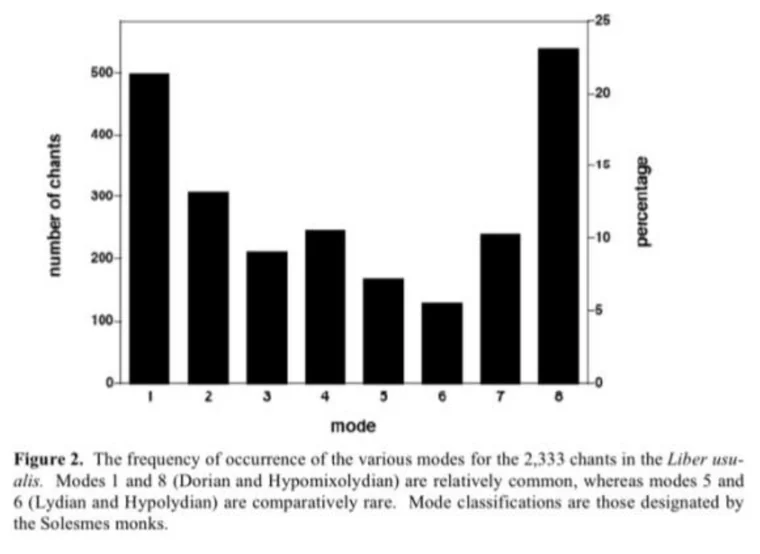
These modes were in turn inherited by the early Christians and used in the performance of plainchant — or plainsong — which later still became known as Gregorian chant. The (modern) Dorian mode became the most widely used scale of early Christian plainchant, followed closely by the Mixolydian and Phrygian modes — and when the chants are actually counted, mode by mode, the minor-flavoured Dorian family's dominance is plain to see:
The Troubadours, and the Aeolian arrives — 500 to 1500 AD
The popularity of the Dorian mode extended into the secular music of the Medieval period, such as the songs of the Troubadours, Trouvères and Minnesingers. At this point the use of the Aeolian mode also became slightly more prominent — although it was not known by that name at the time. The scale running A to A was referred to as Hypodorian; the name Aeolian was given to it much later, by Henricus Glareanus, in his 1547 treatise on music theory, the Dodecachordon.
The Renaissance leans major — 1400 to 1600 AD
The Renaissance period was beginning to show a leaning towards the major (Ionian) tonality, perhaps spurred on by a greater cultural desire for emotional expression. Glareanus himself noted that the Ionian was the mode his contemporaries reached for most. Modern corpus studies — researchers clustering thousands of pieces by the notes they actually use — find exactly this narrowing:
The common practice period — 1600 to 1900 AD
The use of major tonality was increasing by the time of the common practice period (which evolved gradually out of the modal system), by which time the employment of the major scale had grown drastically — but notice how the Aeolian mode was becoming more prominent too. This is the era in which the whole system funnelled down to two scales: major and minor.
However, something interesting was taking place that had formed in the early Renaissance — the chromatic alteration of the minor modes to produce a major dominant chord with a stronger pull towards the tonic. Back then it was referred to as musica ficta, but this was beginning to take the form of what would later be known and codified as the Harmonic minor scale, followed closely by the development of the Melodic minor scale.
1900 to the present day
By the 20th century, modal music was beginning to come back into favour — nowhere more apparent than in the birth of the Blues, Jazz and Pop music, as well as later Film music. But still, the minor modes were taking a back seat in comparison to the major scale. The one big recent twist: count the actual hits, and the minor key has been catching up fast for half a century.
So, what makes minor, minor?
The 3rd of any chord or scale dictates whether that chord or scale is major or minor. As the name implies — smaller, or lesser; the Latin word for smaller is indeed minor — the minor 3rd is simply a smaller interval than a major 3rd: three semitones from the root, as opposed to four for the major.
The fact that the minor 3rd sits closer to the root also increases its dissonant value — the closer an interval gets to its root, the higher its dissonance becomes; think of the minor 2nd, or the major 7th. This is one of the most important aspects of Western music, because these physical traits carry the tension and release in every genre and style.
Minor = sad… but not always
The normal perception — the accepted view — of minor scales, chords, or pieces composed in a minor key is that they are sad. There are cultural, physical and psychoacoustic reasons for this. But, as with many things in music, it is not always the case — or as it seems.
The first thing to consider is the harmonic series. The 5th harmonic of any fundamental note naturally produces a pure major 3rd; it is not until you reach the far weaker 19th harmonic that a minor 3rd appears above the root in the series. That minor 3rd, when played, creates a dissonant minor 9th clash against the major 3rd genuinely contained within the tone underneath — whether that tone is played on a string, blown, struck or sung. Slide one note against another and you can watch the roughness rise and fall — and see that the minor 3rd sits in a shallower valley of smoothness than the major 3rd:
Those two valleys are not equally deep because of wave interference. Play a root with its major 3rd and the two waves settle into a short, tidy repeating pattern; play the same root with its minor 3rd and the combined wave takes far longer to repeat — busier, rougher, perceived (if only at a subconscious level) as less settled. The first clue as to why minor reads as sad.
The second clue is cultural. The basis of Western harmony is often called major–minor tonality — governed by major and minor 3rds and by the pull of the dominant — and it grew from the common practice period, when only two scales were in use: the major scale (Ionian) and the natural minor (Aeolian, built from the 6th degree of the major scale). That system was established during the Baroque era (1600–1750), marking the beginning of the common practice period, and the transition it made was from a primarily modal system — inherited from the church modes of Gregorian chant — to major/minor tonality ruled by the tonic–dominant relationship. Culturally, we have been trained by four centuries of that system to hear minor pieces as belonging to sad events. (Years later, modern pop, film music and jazz have returned to modal writing in some respects.)
The third clue is in speech. The relationship between pitches is an important cue for conveying emotion in music — and the minor 3rd is generally acknowledged to convey sadness when it occurs in the pitch contour of sad speech, or in non-verbal emotional expression. Acoustic analysis has revealed that the pitch relationships in sad speech tend to approximate a minor 3rd:
“The musical interval referred to as the minor third is generally thought to convey sadness. We reveal that the minor third also occurs in the pitch contour of speech conveying sadness. Bisyllabic speech samples conveying four emotions were recorded by 9 actresses. Acoustic analyses revealed that the relationship between the 2 salient pitches of the sad speech samples tended to approximate a minor third.”
— Curtis & Bharucha (2010), Emotion, 10(3)
“Research seems to indicate that this exact constellation of two notes — a falling minor 3rd — is the same all over the world, wherever children tease each other, on every continent and in every culture.”
— Leonard Bernstein, The Unanswered Question (1973 Harvard lectures)
That falling minor 3rd is the pair of notes the whole Mad World lesson hangs on — and if you want the sound of the minor 3rd versus the major 3rd properly in your ear, the free Interval Ear Trainer will happily test you on exactly that pair all day.
Having said all that — minor pieces are not always perceived as sad, and neither are all major pieces happy. Consider this list:
In a minor key, yet happy:
- Move on Up
- Uptown Funk
- I Wish
- Just Dance
- Smooth
- September
- Badinerie (Orchestral Suite No. 2 in B minor)
In a major key, yet sad:
- Tears in Heaven
- Everybody Hurts
- Nothing Compares 2 U
- Fix You
- Both Sides Now
- Yesterday
- The Scientist
- Bridge Over Troubled Water
Each piece above seems to defy the notion that minor = sad and major = happy. Emotion in music is never clear cut: what is psychoacoustically expected to sound happy or sad, dependent on major/minor tonality, is not always perceived that way.
Putting psychoacoustics aside, this is a good point at which to introduce some of the minor scale family. To keep things simple, the Locrian mode is not included.
The minor scale family tree
Antiquity chose the Dorian and Phrygian (with their interchangeable names!) as the preferred modes for thousands of years. Here, though, we will treat the diatonic natural minor — the Aeolian — as the parent scale, and follow its chromatically altered family tree. The offspring are relative newcomers compared to the lengths of time involved: musica ficta — chromatically raising the 7th of a minor mode at a cadence — appears in the 1300s, its use becomes fixed and widespread through the Baroque (1600–1750) and Classical (1750–1820) periods, and the names harmonic and melodic minor only settle in the mid-1800s.
Meet the family…
Every card below is built the same way: the scale from C in notation and TAB, the one-octave fretboard shape, and the tone/semitone pattern — plus which two tetrachords the scale is made of. (T = tone, S = semitone — whole step and half step if you prefer the American terms.)
Aeolian
Also referred to in modern terms as the natural minor — built from the 6th scale degree of the major scale (Ionian). Throughout antiquity its formal name was Hypodorian. The Aeolian mode was used infrequently in ancient Greece, but its use grew in prominence during the Renaissance period — John Dowland's “Flow My Tears” being one of the best-known examples. Coupled with the minor 3rd, it is the flat 6th that really gives this scale its melancholy flavour, and an excellent example of that is the lament bassline — a descending device employed by composers from Monteverdi to Mozart (not to mention “Hit the Road Jack”!), and lovingly dissected in Seth Monahan's lesson on the lament bass.
It was mostly replaced in the Baroque and Classical periods by the harmonic minor, but the mode made its return in the pop, film and jazz worlds: “All Along the Watchtower” (Bob Dylan), “Murron's Burial” from Braveheart, and “Blue Bossa” (Kenny Dorham) are good examples from each.
Dorian
As we are looking at the modes in the minor key, we can also see the Dorian scale as mode iv of Aeolian (count A B C D up the A natural minor scale). As we have seen, the Dorian mode was perhaps the best-used mode of Medieval plainchant, and just as popular in the secular music of the period. The scale creates its harmonic flavour through the combination of the minor 3rd and major 6th.
It has become a mainstay of pop, film and jazz — the list of songs using this mode could fill a phone book, but “Good Times” stands out, as Bernard Edwards' bassline outlines the entire scale. The Graduate used the classic folk tune “Scarborough Fair” (arranged by Simon & Garfunkel) to very good effect, and “So What” by Miles Davis is perhaps the most iconic use of the Dorian mode in jazz.
More from the Dorian family…
Dorian ♯4
The Dorian ♯4 scale is mode iv of the Harmonic Minor scale, also referred to as the Ukrainian Dorian scale, or the Romanian minor. With the “harmonic cluster” made by the grouping of the 2nd, minor 3rd, sharp 4th and natural 5th giving this scale a distinctly Eastern European sound, it is no surprise that it has been employed in the ethnic music of Romania, in Jewish folk song and, of course, in Ukraine. It also features in John Williams' score for Schindler's List. Perhaps its best-known use in a pop tune is Britney Spears' 2003 hit “Toxic” — the scale appears in the Bollywood-style strings intro.
This is an extremely user-friendly scale for improvising on the bass: it sits under the fingers very well and produces some very interesting sonorities.
Dorian ♭5
Stepping outside the modes built from minor parents, the Dorian ♭5 is mode ii of the Harmonic Major scale — a rarely used scale, and the Dorian ♭5 is just as rarely employed. Which is surprising, as it sits under the fingers very well and has some interesting harmonic and melodic possibilities. It has perhaps been used in a fragmentary way by film composers such as Danny Elfman, but it is unlikely to be heard in the pop world. It would certainly find a home in blues improvisation.
Phrygian
Looked at from the minor side, the Phrygian scale is mode v of Aeolian — and as we have seen, it was a favourite of the ancient Greeks (who knew it as Dorian). It has been present throughout all styles of music since: with its flattened 2nd degree it has a dark sound and a very strong pull back to the tonic, and quite a Spanish flavour — it is widely used in Flamenco.
In pop, film and jazz the Phrygian has made some notable appearances. “White Rabbit” by Jefferson Airplane (coupled with the Phrygian Dominant scale); the prologue theme of The Lord of the Rings: The Fellowship of the Ring, where Howard Shore uses it to evoke something mysterious and ancient; and “Nardis” (Miles Davis / Bill Evans), a classic use of the scale in jazz.
A distant cousin…
Phrygian ♭4
Another step outside the minor parents: the Phrygian ♭4 is mode iii of the Harmonic Major scale — rarely used, and the Phrygian ♭4 even more so. “322” by Creo is a heavy-metal electronic track that is a very rare example of a song explicitly written to exploit this mode. The ♭4 scale degree sounds like a major 3rd sitting inside an otherwise dark scale, which gives it some genuinely interesting improvisational possibilities.
Harmonic Minor
The Harmonic minor's sound comes from the mixture of a minor 3rd and a major 7th, along with the augmented 2nd between the ♭6 and that 7th. “Back to Black” is a good example of its use in a pop vocal melody.
It has often been said that the leading tone — the major 7th — is probably the most significant factor in tonal music, and that is exactly how the Harmonic minor came into being during the early Baroque period: not so much as a scale, but derived from an altered dominant chord. The natural minor (Aeolian) was chromatically altered to provide a sharpened leading tone, creating a stronger gravitational pull from chord V7 resolving to chord i in the minor key. This did, however, create an augmented 2nd between the flat 6th and the major 7th — looked upon as an “awkward” interval, especially when sung — and so the Harmonic minor was modified with a major 6th, creating the Melodic minor scale.
Harmonic minor ♯4 — the Hungarian minor scale
Also referred to as the Gypsy minor scale, or the Double Harmonic minor. This scale is identical to the Harmonic minor apart from a ♯4 — hence the name above. It is the 4th mode of the Double Harmonic Major scale, but it is also looked upon as an independent scale in its own right — which is perhaps one way of looking at all modes.
A striking aspect of this scale is the collection of three notes all a semitone apart, creating a chromatic enclosure around the 5th degree. “Bad Guy” by Billie Eilish uses a fragment of this scale.
Melodic Minor
The Melodic minor developed during the Baroque era to smooth out the angular augmented 2nd of the Harmonic minor in melodic part-writing. The raised 6th and 7th give an even voice leading up to the root — and those intervals were often flattened again on the way down, though Bach broke that rule often. The Beatles did not: listen to “Yesterday”.
There are some wonderful modes built from this scale — two of them are in this family gallery, and there are more besides. The melodic possibilities are reflected in the sheer number of compositions that have employed it across its history.
Neapolitan Minor
Perhaps best described as the Harmonic minor with a flattened 2nd — or, alternatively, as the Double Harmonic Major with a flattened 3rd. It is not a commonly used scale, although it was used by Italian Baroque composers such as Scarlatti and Pergolesi, having grown out of the use of the Neapolitan ♭II chord (itself somewhat mis-named, as the chord developed organically, and much earlier, in the broad context of European art music). This scale also fits the opening chords of “A Night in Tunisia” surprisingly well.
The Neapolitan minor is still very much worth exploring for the sheer variety of phrases and patterns within the scale and its modes — some of which are very user-friendly and ripe for writing your own bass lines, or improvising. I am surprised it has not found more use in the music world, as it possesses a dark and rich beauty that is open to a multitude of possibilities.
Neapolitan Major
Perhaps a misnomer: the Neapolitan Major is so named because it has a major 6th degree instead of a minor 6th, which is the only difference between it and the Neapolitan minor. It can equally be looked upon as a Melodic minor with a flattened 2nd — and it is an interesting, odd fact that this creates a string of five whole tones separated by two semitones, a chromatic enclosure around the root. That is two semitones away from being a complete whole-tone scale!
On the one hand this creates some interesting improvisational possibilities (straying from the minor scales for a moment, mode IV — Lydian Dominant ♭6 — is a delight to play); on the other, it presents quite a few difficult-to-use modes, not to mention a lot of augmented harmony, which perhaps explains why the scale is so rarely employed. It developed in the Baroque era for the same reason the Melodic minor did: to smooth out the Neapolitan minor's augmented 2nd in melodic part-writing, the raised 6th and 7th giving an even voice leading to the root.
More of the Aeolian family…
Two more members complete the tree above — both of them modes of the Melodic minor.
Aeolian ♭5
Mode vi of the Melodic minor, also referred to as the Locrian ♮2 (Locrian natural 2nd).
Dorian ♭2
Mode ii of the Melodic minor, also referred to as the Phrygian ♮6.
The download below prints the whole story for the music stand: the history, the family tree, and every card in this gallery — notation, TAB, fretboard shape and tetrachord split for all thirteen scales — plus the full reading list.
Minor scale FAQs
- What is the minor scale?
- The natural minor scale is 1 2 ♭3 4 5 ♭6 ♭7 — in C, that is C D E♭ F G A♭ B♭. It is the Aeolian mode, built from the 6th degree of the major scale, and it is the parent of a whole family: raise its 7th and you get the harmonic minor, raise the 6th as well and you get the melodic minor. (For where the natural minor sits among the five scale families of pop, see Bass Scales: The Complete Map.)
- What makes a scale minor?
- The 3rd. A minor 3rd is three semitones above the root where a major 3rd is four, and that one interval decides whether a scale or chord is minor. The name is literal: minor is Latin for smaller, and the minor 3rd is simply the smaller of the two 3rds.
- What is the difference between natural, harmonic and melodic minor?
- One note at a time. Natural minor is 1 2 ♭3 4 5 ♭6 ♭7; the harmonic minor raises the 7th to create a leading tone (and with it an augmented 2nd between ♭6 and 7); the melodic minor raises the 6th as well, smoothing that awkward leap back out. Historically the raised 7th came first, as musica ficta at cadences, and the melodic minor followed to fix the interval the alteration created.
- Why does the minor scale sound sad?
- Three reasons working together: physics — the minor 3rd clashes gently with the major 3rd that lives inside every musical tone's harmonic series, producing a rougher interference pattern; culture — four centuries of major/minor tonality have trained Western ears to file minor keys under sad; and speech — the pitch contour of sad speech tends to approximate a falling minor 3rd. None of it is absolute: plenty of happy music is in minor keys.
- Is the minor scale older than the major scale?
- Effectively, yes. Minor-flavoured modes — Dorian and Phrygian above all — were the favourite scales of the ancient world and of a thousand years of plainchant, while the major scale (Ionian) only took over in the last four hundred years or so. The names harmonic minor and melodic minor are younger still, settling in the mid-1800s.
- How many minor scales are there?
- More than three. Beyond natural, harmonic and melodic minor, the family includes Dorian and Phrygian (the ancient favourites), their altered cousins Dorian ♯4, Dorian ♭5, Dorian ♭2 and Phrygian ♭4, the Hungarian minor, both Neapolitan scales, and the Aeolian ♭5 — thirteen scales in this lesson alone, all with a minor 3rd at their heart.
Further reading
Pete's sources for this lesson, plus the sources behind each chart:
- Bernstein, Leonard (1976). The Unanswered Question. Cambridge, MA: Harvard University Press. (The 1973 Norton lectures; the teasing-chant quote is from Lecture 1, “Musical Phonology”. The lectures are also on YouTube.)
- Curtis, Meagan E. & Bharucha, Jamshed J. (2010). ‘The minor third communicates sadness in speech, mirroring its use in music’, Emotion 10(3), 335–348. PubMed 20515223.
- Huron, David & Veltman, Joshua (2006). ‘A Cognitive Approach to Medieval Mode: Evidence for an Historical Antecedent to the Major/Minor System’, Empirical Musicology Review 1(1), 33–55. doi:10.18061/1811/24072 — the source of the chant-count chart.
- Harasim, Daniel; Moss, Fabian C.; Ramirez, Matthias & Rohrmeier, Martin (2021). ‘Exploring the foundations of tonality: statistical cognitive modeling of modes in the history of Western classical music’, Humanities and Social Sciences Communications 8:5. nature.com — the mode-collapse evidence, with Albrecht et al. (2014) for the 1400–1750 series.
- Schellenberg, E. Glenn & von Scheve, Christian (2012). ‘Emotional cues in American popular music: Five decades of the Top 40’, Psychology of Aesthetics, Creativity, and the Arts 6(3) — the major-vs-minor hit-parade data.
- Guillemot, Luc (2025). ‘Visualizing dissonance’, Datawrapper blog, 21 August 2025. datawrapper.de — the essay behind the dissonance curve, itself built on William Sethares' model of sensory dissonance (after Plomp & Levelt, 1965).
- de Rose, Sara (2021). ‘A Proposed Mesopotamian Origin for the Ancient Musical and Musico-Cosmological Systems of the West and China’, Sino-Platonic Papers 320. University of Pennsylvania.
- Nikolsky, Aleksey (2021). ‘The Ancient Greek roots of Mediterranean Tonality and its Hemiolic Typology and their antithesis to Western tonality’. ResearchGate.
- Morley, Iain (2013). The Prehistory of Music: Human Evolution, Archaeology, and the Origins of Musicality. Oxford University Press.
- Wallin, Nils L.; Merker, Björn & Brown, Steven (eds.) (2000). The Origins of Music. MIT Press.
- Schwartz, David A.; Howe, Catherine Q. & Purves, Dale (2003). ‘The Statistical Structure of Human Speech Sounds Predicts Musical Universals’, Journal of Neuroscience 23(18), 7160–7168.
- Huron, David & Veltman, Joshua — see above; and for the ancient world, Plato, Republic 398e–399a and Aristotle, Politics VIII are the classic mode testimonies.
- Seashore, Carl E. (1967). Psychology of Music. New York: Dover.
- Sapovadia, Vrajlal (2025). Harmony in Isolation: Parallel Development of Pentatonic Scales in Disconnected Cultures. Professor of Practice, NFSU.
- Kolinski, Mieczyslaw. ‘Mode’, Encyclopædia Britannica (online; accessed August 2026). britannica.com.
- Day-O’Connell, Jeremy. ‘Pentatonic’, and Drabkin, William. ‘Diatonic’, The New Grove Dictionary of Music and Musicians, ed. Stanley Sadie. London: Macmillan.
- Rotem, Elam (Early Music Sources): Gregorian chant and Modes in the 16th and 17th centuries (videos).
- Monahan, Seth: The Lament Bass (video).
- Faraji, Farya: Ancient Greek and Roman Music — A Beginner's Introduction (video, 2022).
- Dalessio, Greg: All the diatonic scales and modes (video, 2021) — the source of the tone/semitone ribbon idea used in the diagrams here.
- Music Theory for Guitar: The Neapolitan Minor Scale and the Neapolitan Chord and Making music with the Neapolitan Major Scale (videos, 2019).
Notes